

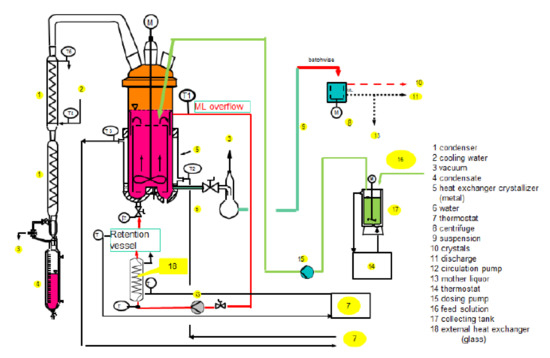
Crystallization is one of the most important separation and purification processes used in the chemical, pharmaceutical, food, and specialty manufacturing industries. It enables dissolved substances to transform into solid crystals under controlled conditions, resulting in products with high purity and consistent quality. A crystallizer tank is the core piece of equipment that facilitates this process by providing the right environment for crystal formation and growth.
A properly designed crystallizer tank helps control temperature, concentration, and mixing conditions so crystals develop evenly while minimizing impurities. Stable operating conditions improve product consistency, reduce material waste, and enhance production efficiency across many industrial applications.
Table of Contents
ToggleWhat Is a Crystallizer Tank?
A crystallizer tank is an industrial vessel specifically designed to produce solid crystals from a liquid solution. During the crystallization process, a dissolved substance becomes supersaturated, allowing crystals to form and gradually grow. The tank maintains the necessary process conditions to support controlled crystal development until the desired crystal size is achieved.
Crystallizer tanks can operate in either batch or continuous processes, depending on production requirements and the characteristics of the material being processed.
How Does a Crystallizer Tank Work?
The crystallization process generally follows several key steps:
1. Solution Preparation
The process begins by preparing a solution containing the dissolved material. The concentration is carefully adjusted to ensure suitable conditions for crystallization.
2. Creating Supersaturation
Supersaturation is achieved by lowering the solution temperature, evaporating part of the solvent, or modifying the solution composition. This stage encourages crystals to begin forming.
3. Nucleation
Tiny crystal particles, known as nuclei, start to develop within the supersaturated solution. These particles become the foundation for larger crystal growth.
4. Crystal Growth
As more dissolved material attaches to the crystal surfaces, the crystals gradually increase in size. Proper mixing and temperature control help produce uniform crystals with consistent quality.
5. Crystal Separation
Once the crystals reach the required size, they are separated from the remaining liquid using filtration, centrifugation, or other separation methods before further processing.
Main Components of a Crystallizer Tank
A typical crystallizer tank consists of several important components that support efficient operation:
- Agitation system for uniform mixing
- Heating or cooling jacket for precise temperature control
- Internal baffles to improve liquid circulation
- Sensors for monitoring temperature and pressure
- Product discharge outlet
- Inspection and maintenance ports
Each component contributes to maintaining stable operating conditions throughout the crystallization process.
Types of Crystallizer Tanks
Different industries use different crystallizer designs depending on their production needs.
Cooling Crystallizers
Cooling crystallizers reduce the solution temperature to decrease solubility and promote crystal formation. They are widely used in pharmaceutical and chemical manufacturing.
Evaporative Crystallizers
These systems remove solvent through evaporation, increasing the concentration until crystals begin to form naturally.
Vacuum Crystallizers
Vacuum crystallizers lower the solvent’s boiling point, allowing crystallization to occur at reduced temperatures. They are especially useful for heat-sensitive materials.
Draft Tube Baffle Crystallizers
These advanced systems improve internal circulation, encourage uniform crystal growth, and minimize crystal damage during operation.
Common Industrial Applications
Crystallizer tanks are used across numerous industries because they provide reliable and efficient crystal production.
Some common applications include:
- Pharmaceutical manufacturing
- Chemical processing
- Fertilizer production
- Sugar refining
- Salt production
- Food processing
- Specialty chemical manufacturing
Each application requires careful process control to achieve the desired crystal size and purity.
Benefits of Using a Crystallizer Tank
Using a crystallizer tank offers several operational advantages:
- Produces high-purity crystals
- Improves product consistency
- Enhances manufacturing efficiency
- Reduces material waste
- Supports precise process control
- Scales easily for different production capacities
- Lowers long-term operating costs
These advantages make crystallizer tanks an essential part of many industrial manufacturing processes.
Factors That Influence Crystallization Performance
Several operating conditions directly affect crystallization efficiency and product quality.
Temperature
Accurate temperature control determines both the rate of crystallization and the final crystal size.
Mixing
Consistent agitation distributes heat evenly throughout the solution while preventing excessive crystal breakage.
Supersaturation
Maintaining the proper supersaturation level balances crystal formation and crystal growth, resulting in better product quality.
Residence Time
Allowing sufficient time inside the tank enables crystals to grow to the desired size before they are removed from the system.
Maintenance Best Practices
Routine maintenance is essential for reliable operation and long equipment life. Regular inspections should include checking agitators, seals, temperature control systems, and internal surfaces for buildup or wear.
Scheduled cleaning is equally important, especially in industries where contamination can affect product quality. Preventive maintenance helps reduce downtime while ensuring consistent process performance.
Conclusion
A crystallizer tank is a critical piece of industrial equipment that enables controlled crystal formation through precise management of temperature, mixing, and supersaturation. By creating optimal conditions for crystal growth, these systems help manufacturers produce high-quality crystalline products efficiently and consistently. Understanding how a crystallizer tank works allows industries to optimize production processes, improve product quality, and maintain reliable manufacturing operations.




More Stories
Wudu Basin Installation: Important Measurements and Plumbing Considerations
Enjoy Smooth, Creamy Coffee Creations with an Efficient Electric Milk Frother
China B87 Air Pick: Specifications, Heavy-Duty Applications, and Performance Advantages