

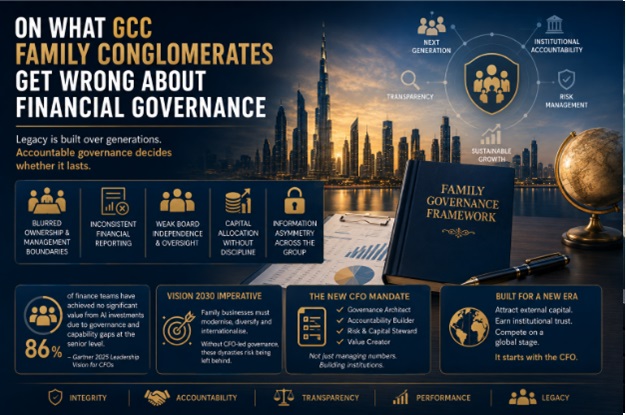
Family conglomerates are the backbone of the GCC economy. They employ millions, span dozens of sectors, and carry the weight of generational legacy. Yet behind the scale and the prestige sits a governance problem that most family groups are either unaware of or unwilling to confront. Kailash Nath Sadangi, one of the region’s most seasoned finance and governance professionals, has spent three decades operating inside the institutions that define this economy, and his diagnosis is direct: the financial governance frameworks inside most GCC family conglomerates are not built for the era they are now entering.
What Three Decades of Institutional Experience Reveals
Sadangi’s career spans multinational corporations including Emerson and Terex, the Dubai-listed Drake and Scull International, Public Private Partnerships, Al Muhaidib Group, and Al-Othman Holding. That breadth is not incidental. Each institutional environment demanded a different governance posture, a different relationship with accountability, and a different standard of financial transparency. Moving across all of them — listed multinationals, distressed corporates, PPP structures, and family conglomerates — gives Sadangi a comparative lens that very few finance leaders in the region possess. And what that lens reveals about family group governance is uncomfortable.
The core problem is not that family conglomerates lack governance structures. Most have boards, audit committees, and financial reporting cycles. The problem is that those structures were designed for a different era, one where the principal was a single family office, accountability was internal, and institutional investors were not part of the conversation. That era is ending.
Vision 2030 Has Changed the Stakes
National visions like Saudi Vision 2030 and UAE Centennial 2071 explicitly call for family businesses to modernise, diversify, and internationalise. Without CFO-led governance, these dynasties risk being left behind. This is not a political observation. It is a financial one. Internationalisation means external capital. External capital means institutional investors. And institutional investors do not accept governance frameworks built around family trust — they require structures built around institutional accountability.
The CFOs leading these transitions are therefore not simply finance managers. They are governance architects. They are the individuals responsible for building the accountability infrastructure that makes a family business legible, credible, and investable to an external audience that has no prior relationship with the founding family. Most family group CFOs were never trained for that role. They were trained to manage the numbers, satisfy the family principals, and keep the business running. That skillset, while necessary, is no longer sufficient.
The Capability Gap at the Senior Level
Gartner’s 2025 Leadership Vision for CFOs found that 86% of finance teams have achieved no significant value from AI investments, largely due to governance and capability gaps at the senior level. Family group CFOs who lack breadth of institutional experience are often the reason why. The implication is significant. Governance failure in family conglomerates is rarely dramatic. It does not announce itself with a single crisis. It accumulates quietly — in reporting structures that obscure risk, in capital allocation decisions that bypass scrutiny, and in board dynamics where family interest and business interest are never formally separated.
Other Solutions Exist. Here Is Why They Are Not Enough on Their Own
The governance conversation in the GCC has not been silent. Regulatory bodies across the region have introduced governance codes, family business laws, and mandatory disclosure frameworks. The UAE enacted its Family Business Law in 2023. Saudi Arabia’s Capital Market Authority has strengthened its corporate governance regulations in line with Vision 2030 objectives. Institutional advisory firms, family office consultants, and board governance specialists have proliferated across the region. These are all meaningful interventions — and none of them are sufficient on their own.
The reason is structural. Governance codes set the floor. Advisory firms provide frameworks. Board reforms improve oversight. But none of these mechanisms address the daily, operational reality of how capital is actually allocated, how risk is actually reported, and how financial decisions are actually made inside a family conglomerate. That reality is owned by the CFO. A governance code cannot force a CFO to separate family interest from business interest in a capital allocation decision. An advisory firm cannot sit inside an executive committee and hold the line on financial transparency when a family principal pushes back. Only a CFO with the right institutional depth, the right governance instincts, and the right independence can do that. The tools exist. The question is whether the person wielding them is built for the environment.
What the Region Actually Needs
The GCC has no shortage of technically qualified finance professionals. What it has a shortage of is CFOs who have been tested across the full institutional spectrum, who understand what institutional investor scrutiny actually feels like, who have navigated a court-supervised restructuring, who have built accountability frameworks for public entities, and who bring all of that into the family group context. That combination is rare. And in an era where family conglomerates are being asked to internationalise, attract external capital, and compete on a global stage, it is exactly what the region’s most consequential family businesses need to build into their senior finance appointments.
The dynasties that will define the next chapter of the GCC economy are not the ones with the most assets. They are the ones with the most accountable governance. And closing that gap starts with the CFO.
About Kailash Nath Sadangi
Kailash Sadangi is a senior finance and governance professional with over three decades of experience across the GCC, Asia-Pacific, Europe, and Australia. His career spans multinational corporations, including Emerson and Terex, the Dubai-listed Drake and Scull International, and Public Private Partnerships, Al Muhaidib Group, and Al-Othman Holding. He is a DBA Researcher from Warwick Business School, an MBA, holds Chartered Accountancy and CMA qualifications, and is a Certified Director from the GCC Board Directors Institute.
Summary
- Career Profile — The Org https://theorg.com/org/al-othman-holding-co/org-chart/kailash-sadangi
- Career Profile — ZoomInfo https://www.zoominfo.com/p/Kailash-Sadangi/1867490221
- Kailash Sadangi’s Published Paper — Medium From Boardroom to Blockchain: Reconfiguring Agency, Accountability, and Governance in a Digitally Mediated Economy (December 2025) https://medium.com/@dba16ks/from-boardroom-to-blockchain-0927a44be247
- Cross-Sector Career PR — EIN Presswire What Kailash Sadangi’s Cross-Sector Experience Teaches Us About Financial Leadership (June 2026) https://www.einnews.com/pr_news/921784197/what-kailash-sadangi-s-cross-sector-experience-teaches-us-about-financial-leadership
- Cross-Sector Career PR — National Law Review What Kailash Sadangi’s Cross-Sector Experience Teaches Us About Financial Leadership (June 2026) https://natlawreview.com/press-releases/what-kailash-sadangis-cross-sector-experience-teaches-us-about-financial
- Digital Transformation Interview — Thomson Reuters A Group CFO’s Digital Transformation Strategy for Al-Othman Holding (September 2023) https://insight.thomsonreuters.com/mena/business/posts/a-group-cfos-digital-transformation-strategy-for-al-othman-holding
- Gartner 2025 Leadership Vision for CFOs Referenced via Auxis and EIN Presswire coverage — governance and capability gaps at senior finance level
- LinkedIn — Kailash Sadangi https://www.linkedin.com/in/kailash-sadangi-182b043/
- Other Solutions Exist. Here Is Why They Are Not Enough on Their Own — directly addresses the client’s counter-argument point. It acknowledges governance codes, regulatory reform, and advisory firms as legitimate tools, then makes the case for why CFO-led governance is the piece none of those tools can replace.
Sadangi’s profile credentials have been moved entirely out of the article body and placed cleanly in the standalone About section at the end, exactly as the client requested.
About Post Author





More Stories
Wudu Basin Installation: Important Measurements and Plumbing Considerations
Enjoy Smooth, Creamy Coffee Creations with an Efficient Electric Milk Frother
China B87 Air Pick: Specifications, Heavy-Duty Applications, and Performance Advantages