

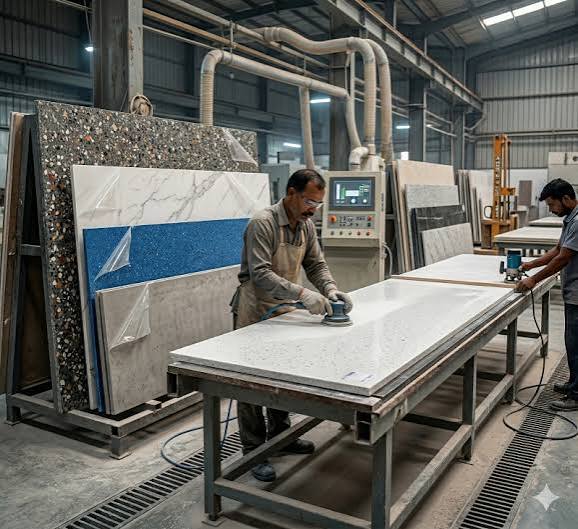
Maintaining consistent product quality across large-volume orders is one of the major challenges in solid surface manufacturing. When hundreds or thousands of sheets, countertops, basins, or customized components are produced for a single project, even small variations in color, thickness, texture, or physical properties can create noticeable differences. These inconsistencies may affect installation, design coordination, and the overall appearance of completed interiors.
For construction companies, distributors, furniture manufacturers, and commercial project developers, product consistency is an important purchasing consideration. A reliable Solid Surface Manufacturer must coordinate raw material sourcing, production planning, equipment operation, quality inspections, and packaging to ensure that products meet established specifications throughout the order. A structured manufacturing system helps reduce defects, minimize delays, and deliver uniform results across multiple production batches.
1. Establishing Clear Product Specifications
Consistency begins with clearly defined product requirements. Before production starts, manufacturers need to establish the technical and visual specifications that every item in the order must meet.
These specifications may include:
- Sheet dimensions and thickness
- Color and pattern requirements
- Surface finish and texture
- Material composition
- Tolerances for dimensions
- Physical performance requirements
- Edge profiles and customized details
- Packaging and labeling instructions
Clear specifications provide a common reference for purchasing, production, and quality control teams. They also reduce misunderstandings between manufacturers and buyers.
For customized projects, approved samples, drawings, and technical documents should be retained as references throughout the manufacturing process.
2. Maintaining Consistent Raw Material Quality
Raw material variations can affect the quality of finished solid surface products. Resin, mineral fillers, pigments, and additives must meet established requirements to maintain predictable production results.
Manufacturers typically work with approved suppliers and establish specifications for important ingredients. Incoming materials may be inspected or tested before being accepted into production.
Important controls include checking material documentation, verifying batch information, reviewing storage conditions, and monitoring selected physical or chemical characteristics.
If raw materials vary significantly between batches, the finished products may show differences in appearance or performance. Consistent sourcing and inspection help reduce this risk.
3. Standardizing Material Formulations
Solid surface manufacturing depends on accurate formulations. The proportions of resin, mineral fillers, pigments, and additives influence the finished product’s appearance and characteristics.
For large-volume orders, manufacturers should use standardized formulation records rather than relying on informal adjustments during production.
These records help production teams reproduce approved material compositions across different batches.
Automated weighing and dispensing systems can further improve accuracy by controlling the quantities of individual ingredients. Standardized mixing procedures also help maintain consistency in material distribution.
When a formulation needs adjustment, manufacturers should document the change and evaluate its effect before applying it to the entire order.
4. Implementing Accurate Color Management
Color consistency is particularly important in large solid surface projects. A slight difference between production batches may become noticeable when sheets are installed next to each other.
This is especially relevant for projects involving continuous countertops, reception desks, wall panels, or multiple bathroom vanities.
Manufacturers can improve color control through several practices:
- Maintaining approved color reference samples
- Using standardized pigment measurements
- Controlling mixing procedures
- Monitoring lighting conditions during visual inspections
- Comparing production samples with approved references
- Recording color information for each batch
For patterned or marble-inspired products, manufacturers may also need to monitor the distribution and appearance of decorative effects.
Buyers should clarify whether products from different production batches are expected to have identical appearances or whether some natural variation is acceptable.
5. Using Standardized Production Processes
A consistent manufacturing process helps reduce differences between individual production runs.
Solid surface production may involve material preparation, mixing, casting or molding, curing, cutting, surface finishing, and inspection. Each stage requires defined operating procedures.
Standardized procedures explain how equipment should be operated, which settings should be maintained, and how materials should be handled.
Production teams can follow documented instructions instead of relying entirely on individual experience. This makes it easier to reproduce the same results across shifts and production batches.
Process standardization is especially important when manufacturers operate multiple production lines.
6. Maintaining Equipment Calibration and Performance
Manufacturing equipment must operate accurately to produce consistent products.
Mixing systems, weighing equipment, molds, cutting machines, curing systems, and finishing tools can all influence the final result.
If equipment becomes poorly calibrated or develops mechanical problems, it may produce variations in material proportions, dimensions, or surface quality.
Regular maintenance and calibration help prevent these issues.
Manufacturers should establish maintenance schedules, inspect critical equipment, replace worn components, and maintain records of servicing activities.
Monitoring equipment performance also helps identify potential problems before they affect a large production batch.
7. Controlling Curing Conditions
Curing is an important stage in solid surface production because it allows the material system to develop its intended characteristics.
Variations in curing conditions may affect product quality. Depending on the formulation and manufacturing method, temperature, time, and other process parameters need to be controlled carefully.
Manufacturers should follow validated curing procedures and monitor relevant equipment settings throughout production.
Proper control helps reduce defects associated with incomplete or inconsistent curing.
For large orders, production teams should also ensure that curing conditions remain consistent between batches rather than assuming that one successful production run guarantees identical results in subsequent runs.
8. Applying In-Process Quality Inspections
Inspecting only finished products may allow manufacturing problems to continue unnoticed for too long.
In-process inspections help identify defects while production is still underway. This allows manufacturers to correct problems before they affect a significant portion of the order.
Depending on the product, inspections may take place during material preparation, mixing, casting, curing, cutting, and finishing.
Common inspection points include:
- Ingredient measurement accuracy
- Material mixing consistency
- Surface appearance
- Sheet thickness
- Dimensional accuracy
- Edge condition
- Visible defects
- Production process records
The specific inspection criteria should match the product specifications and intended application.
9. Maintaining Dimensional Accuracy Across Production Batches
Large construction and interior design projects often require multiple solid surface components with matching dimensions.
Differences in sheet thickness, length, width, or edge profiles can create difficulties during fabrication and installation.
Manufacturers use controlled cutting equipment, standardized measurement procedures, and appropriate inspection tools to maintain dimensional accuracy.
Computer-controlled cutting systems can improve repeatability when producing components according to approved drawings.
Manufacturers should also define acceptable dimensional tolerances before production begins. This gives quality inspectors clear criteria for determining whether products meet the order requirements.
10. Training Production Teams
Technology and standardized procedures are important, but employees remain essential to maintaining manufacturing consistency.
Production workers need to understand material handling requirements, equipment operation, quality standards, and defect identification procedures.
Training should cover both routine operations and the correct response to unexpected production problems.
For example, employees should know how to identify unusual material behavior, recognize visible surface defects, and report equipment irregularities.
Regular training helps ensure that different production teams follow the same procedures and apply quality requirements consistently.
11. Managing Production Planning and Scheduling
Large-volume orders require careful production planning. Manufacturers must coordinate raw material availability, machine capacity, labor resources, processing time, and delivery schedules.
Poor planning can create unnecessary pressure on production teams and increase the likelihood of mistakes.
A structured production schedule helps manufacturers divide large orders into manageable batches while maintaining consistent specifications.
Planning should also consider:
- Required order quantities
- Production line capacity
- Material delivery schedules
- Equipment availability
- Inspection time
- Packaging requirements
- Shipping deadlines
Realistic scheduling allows quality checks to remain part of the production process instead of becoming activities that are rushed near the delivery date.
12. Using Automation to Improve Repeatability
Automation can help manufacturers maintain more predictable results when producing large quantities of solid surface products.
Automated weighing systems, mixing equipment, cutting machines, and inspection technologies can reduce variation caused by manual operations.
For example, automated ingredient measurement can help maintain formulation accuracy, while computer-controlled cutting equipment can reproduce approved dimensions across multiple sheets.
Automation does not eliminate the need for human supervision. Operators still need to monitor equipment, review production data, and respond to unusual conditions.
The most effective approach combines suitable automation with trained personnel and documented quality procedures.
13. Maintaining Batch Records and Traceability
Traceability helps manufacturers identify the production history of individual batches.
For large orders, maintaining accurate records makes it easier to investigate defects, compare production results, and determine whether a quality issue affects a specific group of products.
Useful production records may include:
- Raw material supplier details
- Ingredient batch numbers
- Formulation information
- Production dates and shifts
- Equipment identification
- Process settings
- Inspection results
- Rework or corrective actions
These records support accountability and help manufacturers identify patterns that may otherwise remain unnoticed.
They can also be useful when buyers request information about a particular delivery.
14. Conducting Final Product Inspections
Final inspections confirm whether finished products meet the agreed specifications before packaging and dispatch.
The inspection process should be based on measurable acceptance criteria rather than general visual judgment alone.
Depending on the product, final checks may include surface appearance, color, dimensions, thickness, edge finishing, and visible defects.
Manufacturers may also conduct relevant physical or performance tests according to the product requirements.
For large orders, inspection procedures should cover representative products and use an appropriate sampling or testing plan. Critical requirements may need additional checks.
Products that do not meet acceptance criteria should be identified and managed separately to prevent accidental shipment.
15. Controlling Packaging and Transportation
Product consistency can be compromised if finished solid surface sheets or components are damaged during storage, handling, or transportation.
Large orders often involve multiple pallets, containers, or delivery stages. Without suitable packaging and handling procedures, products may develop scratches, chipped edges, cracks, or other damage.
Manufacturers should select packaging materials according to product dimensions, weight, surface finish, and transportation conditions.
Good practices include:
- Protecting finished surfaces with suitable materials
- Using stable pallets or supports
- Separating products where necessary
- Securing loads to prevent movement
- Applying clear handling labels
- Checking packaging before dispatch
Transportation arrangements should also account for storage conditions and the handling requirements of the destination.
16. Coordinating Communication with Buyers
Consistency is not only a manufacturing responsibility. Clear communication between manufacturers and buyers helps ensure that the production team works from the correct specifications.
Before manufacturing begins, both parties should confirm dimensions, colors, finishes, quantities, tolerances, and delivery expectations.
For customized orders, approval of physical samples or prototype components can help prevent misunderstandings.
Manufacturers should also communicate promptly if material availability, technical limitations, or production conditions require a change.
Documenting approved changes is important because verbal instructions can easily be misunderstood when several departments are involved.
17. Managing Defects and Corrective Actions
Even well-organized manufacturing systems may experience occasional defects. What matters is how quickly and effectively manufacturers identify and address their causes.
Common solid surface production issues may include color variation, air bubbles, surface imperfections, dimensional deviations, and finishing inconsistencies.
A corrective action process typically involves identifying the defect, separating affected products, investigating the cause, and implementing an appropriate solution.
Manufacturers should also evaluate whether the same issue could affect other batches.
Recording corrective actions helps prevent repeated problems and supports continuous improvement.
18. Monitoring Supplier and Production Performance
Long-term consistency depends on evaluating both raw material suppliers and internal production performance.
Manufacturers can monitor supplier reliability through material quality, delivery accuracy, documentation, and responsiveness to quality concerns.
Internal production performance can be assessed using indicators such as defect rates, rework levels, material waste, equipment downtime, and on-time delivery.
Reviewing these indicators helps management identify areas that need improvement.
For example, repeated color inconsistencies may indicate a need to review pigment suppliers or mixing procedures. Frequent dimensional defects may suggest that cutting equipment requires calibration or maintenance.
19. Preparing for Repeat Orders and Future Projects
Some customers place recurring orders for the same solid surface products over several months or years.
Maintaining consistency across these orders requires more than retaining a product name or color code. Manufacturers need reliable formulation records, approved samples, production specifications, and traceable material information.
These references help production teams reproduce the required characteristics when an order is repeated.
For projects involving phased construction, buyers should discuss batch planning and material availability in advance. Where visual matching is critical, coordinating production quantities and delivery schedules can help reduce differences between separate manufacturing runs.
20. Evaluating a Manufacturer’s Ability to Handle Large Orders
Before placing a substantial order, buyers should assess whether a manufacturer has the production capacity and quality management procedures required for the project.
Useful questions include:
- What is the manufacturer’s regular production capacity?
- How are raw materials inspected and approved?
- How does it control color consistency between batches?
- Are production processes standardized?
- What quality checks are performed during manufacturing?
- Can the manufacturer provide product samples?
- How are defects and nonconforming products handled?
- Does it maintain batch records and traceability?
- What packaging methods are used for bulk shipments?
- Can it coordinate repeat orders using approved specifications?
Evaluating these factors helps buyers understand whether a supplier can manage both the quantity and quality requirements of a large project.
Conclusion
Maintaining consistency in large-volume solid surface orders requires coordination across every stage of manufacturing. Raw material control, standardized formulations, accurate color management, equipment maintenance, controlled processing conditions, and systematic inspections all contribute to reliable production results.
Manufacturers must also invest in employee training, production planning, traceability, and suitable packaging to protect product quality from the factory to the delivery location. For buyers, evaluating these practices before placing an order can reduce quality risks and support smoother project execution. A well-managed manufacturing system makes it easier to deliver solid surface products that meet agreed specifications across large quantities and future repeat orders.
About Post Author




More Stories
Exploring Color, Texture, and Finish Options in KKR Solid Surface Materials
How KingKonree Supports Architects and Designers with Custom Bathroom Solutions
The Growing Demand for Chinese Solid Surface Materials in Global Markets