

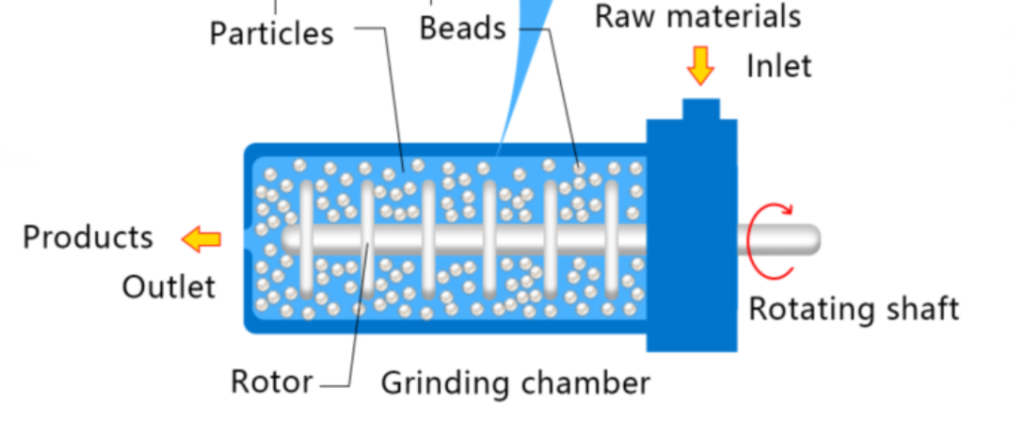
Efficient particle size reduction is essential in industries such as coatings, pharmaceuticals, chemicals, inks, and advanced materials. The ability to control grinding performance directly impacts product quality, consistency, and production efficiency. A properly operated bead milling system ensures uniform particle distribution and stable processing conditions.
A modern bead mill machine works on the principle of high-energy collision between grinding media and material inside a controlled chamber. When operated correctly, it delivers excellent fineness, improved dispersion, and high throughput, making it a key asset in industrial processing lines.
Table of Contents
ToggleUnderstanding the Operation Process of a Bead Mill
The operation of a bead mill involves a continuous grinding mechanism where material is fed into a chamber filled with small grinding beads. A rotating shaft creates high-speed movement, causing the beads to collide with the material and each other.
This repeated impact generates shear and friction forces that gradually break down particles into finer sizes. The processed material is then separated from the grinding media and discharged once the desired particle size is achieved.
The entire process is designed for continuous operation, making bead mills suitable for large-scale production environments where consistency and efficiency are essential.
Key Stages in Bead Mill Operation
1. Feeding the Material
The process begins with the controlled feeding of raw material into the grinding chamber. Proper flow rate is important to ensure stable grinding conditions and prevent overloading the system.
2. Grinding Action
Inside the chamber, the rotor accelerates the beads, creating intense kinetic energy. This energy is transferred to the particles, breaking them down through impact and shear forces.
3. Separation of Beads and Product
Once grinding is complete, the system separates the fine particles from the grinding media using a specialized separation mechanism. This ensures that only processed material exits the system.
4. Discharge and Collection
The final product is discharged in a finely dispersed state, ready for further processing or direct use depending on application requirements.
Factors Affecting Performance Efficiency
The performance of a bead milling system depends on several operational and material-related factors. Optimizing these variables is essential for achieving consistent results.
Grinding Media Size
The size of the beads significantly influences grinding efficiency. Smaller beads are suitable for finer particle reduction, while larger beads are used for coarse grinding stages.
Rotor Speed
Rotor speed determines the energy input into the system. Higher speeds increase grinding intensity but must be balanced to avoid excessive heat generation or wear.
Material Viscosity
The viscosity of the material affects flow behavior inside the chamber. Proper adjustment ensures smooth circulation and effective particle contact with grinding media.
Residence Time
The amount of time material stays inside the grinding chamber directly affects particle size reduction. Longer residence time generally results in finer particles.
Performance Optimization Techniques
Optimizing bead mill performance involves balancing operational parameters to achieve maximum efficiency and product quality.
Selecting the Right Beads
Choosing appropriate bead material and size is critical. Ceramic beads are commonly used for high-precision applications due to their durability and efficiency.
Temperature Control
Heat generation is a natural result of high-energy grinding. Effective cooling systems help maintain stable operating temperatures and prevent material degradation.
Flow Rate Adjustment
Maintaining an optimal flow rate ensures consistent grinding conditions. Too fast a flow may reduce efficiency, while too slow a flow may lead to over-grinding.
Regular Maintenance
Routine inspection of wear parts such as rotors, seals, and chambers ensures long-term efficiency. Proper maintenance reduces downtime and improves operational reliability.
Common Operational Challenges
While bead milling is highly efficient, certain challenges can affect performance if not managed properly.
- Excessive heat buildup during high-speed operation
- Uneven particle distribution due to improper bead selection
- Wear and tear of grinding media over time
- Blockage caused by improper viscosity control
Addressing these issues early helps maintain stable and efficient production.
Industrial Applications of Optimized Bead Milling
When properly optimized, bead mills deliver excellent performance across various industries. They are widely used where precision and consistency are critical.
Typical applications include:
- Paints and coatings requiring smooth finish and durability
- Pharmaceuticals needing stable suspensions and emulsions
- Ink production for consistent color dispersion
- Chemical processing for uniform particle size distribution
- Battery materials for enhanced energy performance
- Nanomaterial production requiring ultra-fine grinding
Each application benefits from controlled operation and optimized milling parameters.
Benefits of Proper Operation and Optimization
When a bead mill is operated under optimized conditions, manufacturers can achieve significant improvements in both efficiency and product quality.
Key benefits include:
- Higher production efficiency with reduced cycle time
- Improved particle size uniformity
- Lower energy consumption per batch
- Enhanced product stability and performance
- Reduced equipment wear and maintenance costs
These advantages contribute to more reliable and cost-effective manufacturing processes.
Conclusion
The operation and performance optimization of bead milling systems play a crucial role in achieving high-quality particle size reduction. From material feeding to final discharge, each stage must be carefully controlled to ensure consistent results.
By optimizing factors such as bead selection, rotor speed, flow rate, and temperature control, manufacturers can significantly enhance efficiency and product quality. A well-managed system ensures that the bead milling process remains a powerful and reliable solution for modern industrial applications.




More Stories
Wudu Basin Installation: Important Measurements and Plumbing Considerations
Enjoy Smooth, Creamy Coffee Creations with an Efficient Electric Milk Frother
China B87 Air Pick: Specifications, Heavy-Duty Applications, and Performance Advantages