

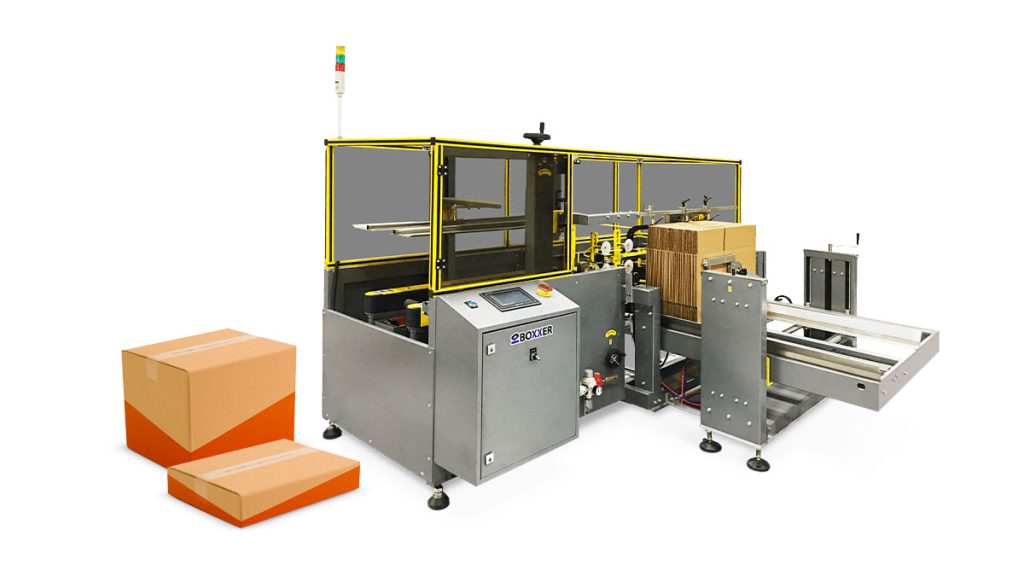
Carton forming is an important stage in industrial packaging because every box must be properly opened and prepared before products can be loaded. As manufacturing and distribution operations become more automated, businesses have access to different technologies designed to make carton preparation faster, more consistent, and easier to manage.
A Case Erecting Machine automates the process of taking flat corrugated blanks, opening them into box shapes, and securing their bottom flaps. However, not all machines use the same operating mechanisms or automation levels. Understanding the available technologies helps manufacturers select equipment that matches their carton specifications, production volume, and packaging requirements.
What Is Case Erecting Machine Technology?
Case erecting technology refers to the mechanical, pneumatic, electrical, and control systems used to transform flat carton blanks into formed boxes. These systems coordinate several operations, including blank feeding, carton opening, flap folding, bottom sealing, and carton discharge.
Depending on the machine design, some operations may be performed through mechanical components, vacuum suction, pneumatic actuators, servo-driven mechanisms, or a combination of technologies.
The main objective is to produce properly formed cartons that can move smoothly to filling, packing, and sealing stations.
1. Manual Case Erecting Systems
Manual case erecting is the simplest approach to carton preparation. Workers open flat carton blanks, fold the bottom flaps, and secure the cartons by hand.
Although this method does not provide the automation of industrial machinery, it may be suitable for small businesses with low packaging volumes or occasional carton requirements.
Key characteristics include:
- Low initial equipment investment.
- Minimal technical complexity.
- Flexibility for different carton sizes.
- Dependence on manual labor.
- Output that varies with operator speed and workload.
Manual carton forming can be practical for limited production, but it becomes less efficient when packaging demand increases.
2. Semi-Automatic Case Erecting Machines
Semi-automatic machines combine mechanical carton forming with operator involvement. Depending on the model, an employee may need to load blanks, initiate the forming cycle, or position cartons for discharge.
The machine then performs selected operations, such as opening the carton and folding or sealing its bottom flaps.
These systems can reduce repetitive manual work without requiring a fully automated packaging line. They are often considered by businesses that want to improve carton preparation while maintaining a relatively simple operating process.
Semi-automatic equipment is particularly useful when production volumes are moderate or carton sizes change frequently.
3. Fully Automatic Case Erecting Machines
Fully automatic systems perform carton feeding, opening, forming, and bottom sealing with limited routine operator involvement. Once the carton magazine is loaded and the machine is configured, it can prepare boxes continuously according to its operating capacity.
These machines are commonly used in high-volume manufacturing and distribution facilities where consistent carton availability is important.
Their main advantages include:
- Reduced dependence on manual carton assembly.
- Consistent carton forming.
- Higher potential production output.
- Easier integration with automated conveyors.
- Support for continuous packaging operations.
The actual level of automation and achievable output depend on the machine model, carton specifications, and production conditions.
4. Vacuum-Based Carton Feeding Technology
Vacuum-based feeding is widely used in automatic case erecting equipment. The system uses suction cups connected to a vacuum source to pick up individual carton blanks from a magazine.
After a blank is separated from the stack, the machine transfers it into the forming area. The blank is then opened into the required box shape.
Reliable vacuum performance is important because poor suction can cause missed picks, double feeding, or carton positioning problems.
When evaluating this technology, manufacturers should consider the quality of the suction components, the suitability of the vacuum system for their carton materials, and the ease of inspecting and maintaining these parts.
5. Mechanical Carton Forming Technology
Mechanical forming systems use coordinated moving components, guides, and folding mechanisms to open and shape carton blanks. These components control the carton as it moves through the forming process.
Mechanical systems are important for maintaining the correct box shape and ensuring that the flaps reach their intended positions.
Their performance depends on accurate adjustment and the condition of moving parts. Regular inspection helps identify wear, misalignment, or other issues that could affect carton formation.
Mechanical forming is commonly combined with other technologies, such as vacuum feeding and pneumatic actuation, to complete the overall process.
6. Pneumatic Case Erecting Technology
Pneumatic systems use compressed air to operate selected machine components. Depending on the design, pneumatic cylinders may control carton movement, folding actions, clamping, or other mechanical operations.
This technology can provide quick and repeatable movement for tasks that do not require highly complex motion control.
However, pneumatic equipment depends on a suitable compressed-air supply. Air pressure, filtration, leakage, and regular maintenance can influence operating reliability.
Manufacturers should check the machine’s air requirements and ensure that their facility can provide the necessary supply.
7. Servo-Driven Case Erecting Technology
Servo-driven systems use electronically controlled motors to manage movement with precise positioning and speed control. Depending on the machine design, servo motors may operate feeding, forming, or transfer mechanisms.
This technology can support accurate movement and flexible adjustments, which may be useful in packaging operations that handle different carton formats.
Servo systems can also offer better control over coordinated machine movements. However, their suitability depends on production requirements, equipment cost, control complexity, and maintenance capabilities.
Businesses should evaluate whether the additional control features provide practical benefits for their packaging process.
8. Tape-Sealing and Hot-Melt Sealing Technologies
After a carton has been opened and its bottom flaps folded, the base needs to be secured before product loading. Case erecting machines commonly use tape or hot-melt adhesive for this purpose.
Tape-Sealing Technology
Tape-sealing systems apply adhesive tape across the carton bottom to hold the flaps together. They are generally straightforward to operate and can be suitable for a range of carton applications.
Manufacturers should check tape width, adhesive performance, application consistency, and the availability of replacement supplies.
Hot-Melt Adhesive Technology
Hot-melt systems apply heated adhesive to selected flap surfaces before the carton is closed. The adhesive then bonds the flaps as it cools.
This method may be appropriate for packaging applications that require a specific bonding performance or sealing configuration.
The choice between tape and hot-melt sealing depends on carton material, product weight, packaging requirements, operating conditions, and maintenance preferences.
9. Sensor-Based Control and Monitoring Technology
Modern case erecting machines may use sensors to monitor carton positions, material levels, machine movement, and operating conditions.
These sensors help coordinate machine operations and detect problems such as missing blanks, carton jams, or incorrect positioning. Depending on the equipment, alerts may be displayed through a control panel to help operators identify faults.
Programmable logic controllers (PLCs) coordinate different machine functions, while human-machine interfaces (HMIs) allow operators to manage settings and view operating information.
Together, these technologies can improve process control and make troubleshooting more straightforward.
Comparing Different Case Erecting Technologies
The following table summarizes the main differences between common machine types and technologies.
| Technology | Main function | Suitable application |
|---|---|---|
| Manual systems | Hand-operated carton forming | Low-volume packaging |
| Semi-automatic systems | Combines operator input with machine operations | Moderate production requirements |
| Fully automatic systems | Performs carton forming with limited manual involvement | High-volume packaging |
| Vacuum feeding | Picks and separates flat carton blanks | Automated blank handling |
| Mechanical forming | Opens cartons and folds flaps | Consistent carton shaping |
| Pneumatic systems | Uses compressed air to operate components | Repetitive machine movements |
| Servo-driven systems | Provides controlled motor movement | Applications requiring precise adjustment |
| Tape or hot-melt sealing | Secures carton bottom flaps | Different carton sealing requirements |
| Sensor and PLC systems | Monitors and coordinates machine operations | Automated process control |
These technologies are not necessarily separate machine categories. Many industrial case erectors combine several of them within one system.
How to Choose the Right Case Erecting Technology
Selecting the right technology depends on how the packaging line operates and what the business needs to achieve. A machine with advanced features is not automatically the best choice if those features do not support the actual production process.
Consider the following factors before making a decision:
Production Volume
Determine the number of cartons required per hour or shift. Higher-volume operations may benefit from fully automatic systems, while smaller facilities may find semi-automatic equipment sufficient.
Carton Size and Material
Confirm the supported carton dimensions, corrugated board specifications, and blank styles. The feeding and forming systems must be compatible with the materials being used.
Packaging Line Integration
Check whether the machine can connect with conveyors, case packers, robotic systems, and carton sealing equipment. Compatible operating speeds and transfer arrangements help maintain a balanced workflow.
Changeover Requirements
If production involves several carton sizes, evaluate how easily the machine can be adjusted. Simple changeover procedures can reduce downtime between packaging runs.
Maintenance and Technical Support
Review maintenance access, spare-parts availability, operator training, and supplier support. These factors influence the machine’s long-term reliability.
Total Operating Cost
Consider the purchase price alongside installation, energy, compressed-air requirements, consumables, servicing, and expected machine utilization.
Conclusion
Different case erecting machine technologies serve different packaging requirements. Manual and semi-automatic systems can suit smaller operations, while fully automatic machines support higher-volume production. Vacuum feeding, mechanical forming, pneumatic and servo-driven movement, sealing systems, and sensor-based controls all contribute to the performance of modern carton forming equipment.
Understanding how these technologies work helps manufacturers compare equipment based on practical requirements rather than specifications alone. By considering production volume, carton compatibility, automation needs, integration, and maintenance, businesses can select a case erecting solution that supports reliable and efficient packaging operations.
About Post Author




More Stories
Understanding the Artistic Techniques Behind Realistic Figurative Oil Painting
Understanding the Materials and Techniques Used in Custom Oil Paintings
A Complete Guide to Polyester Printing Mesh for High-Quality Textile and Screen Printing