

Consistency is one of the most critical requirements in ink manufacturing. Whether used in printing, packaging, or industrial coatings, ink must deliver uniform color strength, stable viscosity, and reliable performance across every batch. Achieving this level of precision depends heavily on process control and equipment design.
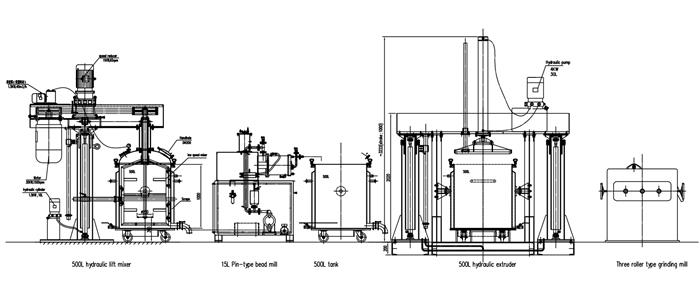
A modern Ink Production Machine is engineered specifically to maintain stability throughout the entire production cycle. Systems like the Ink Production Machine integrate mixing, grinding, dispersion, and monitoring functions to ensure every batch meets strict quality standards.
Table of Contents
TogglePrecise Raw Material Measurement
Quality consistency begins with accurate raw material dosing. Even small variations in pigment or binder ratios can lead to noticeable differences in final ink performance.
Modern systems improve accuracy through:
- Automated weighing and dosing systems
- Controlled raw material feeding units
- Digital measurement verification
- Reduced manual handling errors
This ensures that every batch starts with the same formulation baseline.
Controlled Mixing and Pre-Dispersion
Before fine grinding, materials must be evenly mixed to create a stable slurry. This stage is crucial for preventing inconsistencies later in the process.
Ink production machines ensure consistency by:
- Maintaining uniform mixing speeds
- Preventing pigment clumping
- Ensuring even binder distribution
- Stabilizing slurry viscosity
A well-prepared mixture leads to smoother and more efficient downstream processing.
Stable Grinding and Particle Size Control
Particle size uniformity is one of the most important factors in ink quality. Inconsistent grinding can result in color variation, poor flow, or instability.
Advanced systems control this stage by:
- Regulating grinding speed and pressure
- Using high-efficiency dispersion technology
- Ensuring uniform bead movement in milling chambers
- Monitoring particle size reduction in real time
This helps achieve fine and consistent particle distribution across all batches.
Real-Time Monitoring Systems
Modern ink production machines use sensors and digital monitoring tools to track critical process variables continuously.
These systems monitor:
- Temperature levels
- Viscosity changes
- Flow rates
- Grinding performance
Real-time feedback allows operators to make immediate adjustments, preventing quality deviations before they occur.
Automation Reduces Human Variation
Human error is one of the main causes of inconsistent production results. Automation helps eliminate variability by standardizing all key processes.
Benefits of automation include:
- Consistent process timing
- Accurate parameter control
- Reduced operator dependency
- Repeatable production cycles
This ensures that every batch follows the same controlled process path.
Efficient Dispersion Technology
Proper pigment dispersion is essential for achieving stable color and smooth texture. Modern ink production machines use advanced dispersion techniques to ensure uniformity.
These systems provide:
- High shear force for pigment breakdown
- Even distribution of particles in liquid medium
- Prevention of sedimentation and agglomeration
- Improved color strength consistency
Efficient dispersion directly improves the visual and functional quality of ink.
Temperature and Viscosity Control
Fluctuations in temperature or viscosity can affect ink stability and performance. Consistent output requires strict environmental control throughout production.
Ink production machines maintain stability through:
- Cooling systems to regulate heat
- Automated viscosity adjustment
- Continuous process monitoring
- Controlled circulation systems
These controls help maintain uniform product characteristics.
Filtration and Final Quality Checks
Before packaging, ink passes through filtration systems to remove impurities and oversized particles. This ensures a smooth and defect-free final product.
Key quality control steps include:
- Fine filtration for particle removal
- Batch testing for color consistency
- Viscosity and stability checks
- Final inspection before filling
These steps ensure only high-quality ink reaches the packaging stage.
Standardized Production Processes
Consistency is also achieved through standardized operating procedures. Modern ink production systems follow predefined production recipes for each product type.
This ensures:
- Identical processing conditions for each batch
- Repeatable formulation accuracy
- Reduced production variability
- Easier quality tracking and documentation
Standardization is key to maintaining long-term reliability.
Conclusion
Ink production machines ensure consistent quality output by combining precise material control, automated processing, real-time monitoring, and advanced dispersion technology. Each stage of production is carefully regulated to eliminate variation and maintain stability.
By using a modern Ink Production Machine, manufacturers can achieve uniform particle size, stable formulation, and reliable performance across every batch—making consistency a core strength of efficient and high-quality ink manufacturing.




More Stories
Essential Mining Substation Equipment for Safe and Reliable Power Distribution
How TikTok Creator Tools Help Creators Analyze Performance and Increase Engagement
Wudu Basin Installation: Important Measurements and Plumbing Considerations