

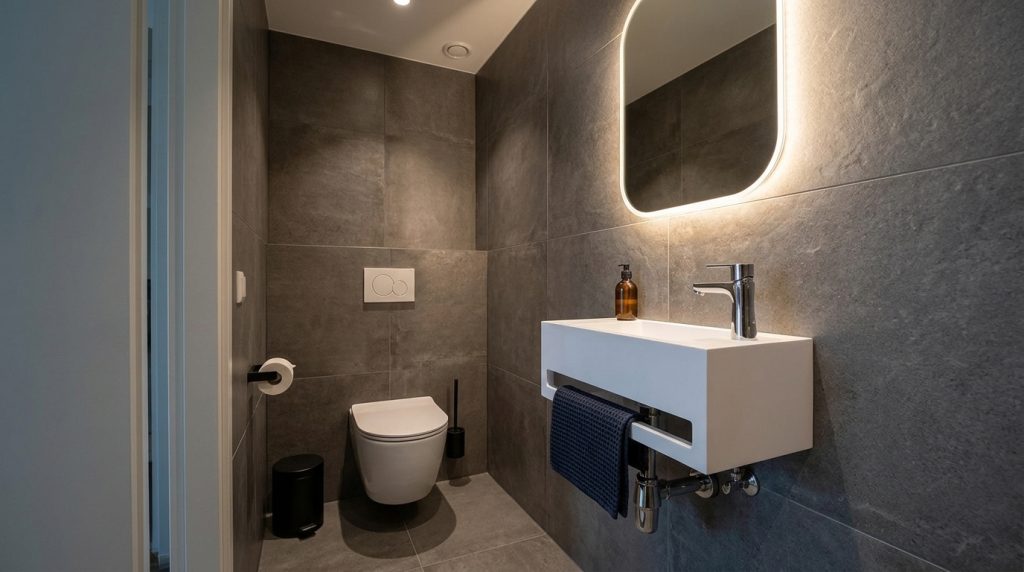
Buying a basin for a small toilet room can seem straightforward until the installation details are considered. A product may look suitable online but prove too deep for the available space, lack the correct tap arrangement, or require plumbing changes that were not included in the budget. Checking these factors before ordering helps prevent delays and reduces the risk of choosing a fixture that does not meet the room’s needs.
Before purchasing small hand basins for toilets, establish the room’s measurements and identify the practical requirements. The product should provide a comfortable washing area, suit the existing water and waste connections where possible, and be supported by clear technical information from the supplier.
1. Measure the installation location accurately
Begin with the finished dimensions of the wall and floor area. Record the available width, the maximum projection, and the height at which the basin is intended to sit. Measure the distance to the toilet, door, and nearby accessories.
Include the full footprint of the tap and any supporting cabinet. A basin may fit within the wall width but still obstruct the entrance if it extends too far into the room. Door swing and standing clearance should be considered as part of the measurement process.
2. Decide which mounting style is suitable
Wall-mounted basins can preserve floor space and create an open appearance. They are useful where a pedestal or cabinet would make movement difficult, but the wall must be able to support the fixture securely.
A vanity-supported basin provides concealed storage and can hide some pipework. A corner model may use an awkward area efficiently, while a pedestal design offers a more traditional appearance. Compare the installation requirements of each type rather than choosing based on appearance alone.
3. Examine the bowl’s usable dimensions
External measurements do not always indicate how practical a basin will be. Check the internal width, depth, and shape. A narrow or shallow bowl may be difficult to use, particularly if the tap produces a strong flow or has a high spout.
Look at where the waste outlet sits and how the sides slope toward it. The design should contain normal splashes and allow enough room for hands beneath the tap. If possible, view a sample before making a final decision.
4. Verify tap compatibility
Check the number and location of tap holes. Some basins accept a deck-mounted mixer, while others are intended for a wall-mounted fitting. The tap’s reach and height should match the bowl so that water falls into the usable area.
Confirm whether the basin is supplied with a tap, waste, overflow fitting, or mounting hardware. Do not assume that accessories shown in product photographs are included in the purchase.
5. Review materials and surface care
Ceramic and glazed finishes are common choices because they provide smooth surfaces and familiar cleaning requirements. Other materials may offer a different appearance or form, but their maintenance needs can vary.
Ask the supplier for material specifications and written care guidance. Check whether abrasive cleaners, strong chemicals, or particular tools should be avoided. A basin that is easy to maintain is especially useful in a frequently used toilet room.
6. Check plumbing and fixing requirements
Confirm the waste outlet position, trap clearance, water supply location, and mounting points. If the basin is intended for a cabinet, make sure the plumbing fits without obstructing drawers or doors. For a wall-mounted product, check whether reinforcement is needed.
If existing connections must be relocated, ask a qualified plumber to assess the work. Include the cost of any changes in the project budget before placing the order.
7. Assess the supplier’s documentation
A reliable supplier should provide accurate dimensions, installation instructions, material details, cleaning advice, and warranty information. Ask how the product is packaged for delivery and what procedure applies if it arrives damaged. For multiple units, confirm availability and consistency between products.
8. Compare the complete cost
The purchase price is only one part of the total expense. Include the tap, waste assembly, mounting hardware, delivery, and installation. A slightly more expensive model may be more economical if it fits the existing services and avoids extensive alterations.
Buy with the installation in mind
The best purchase is one that fits the room and can be installed correctly without compromising comfort. Reviewing dimensions, bowl capacity, fittings, materials, and supplier support before ordering makes the decision more reliable and helps the finished toilet room function as intended.
About Post Author




More Stories
Understanding Receipt Printer Connectivity Options and Compatibility
Why Thermal Receipt Printers Are Popular in Small and Medium-Sized Businesses
Cowboy Hat Plush Designs for Unique and Playful Fashion Looks