

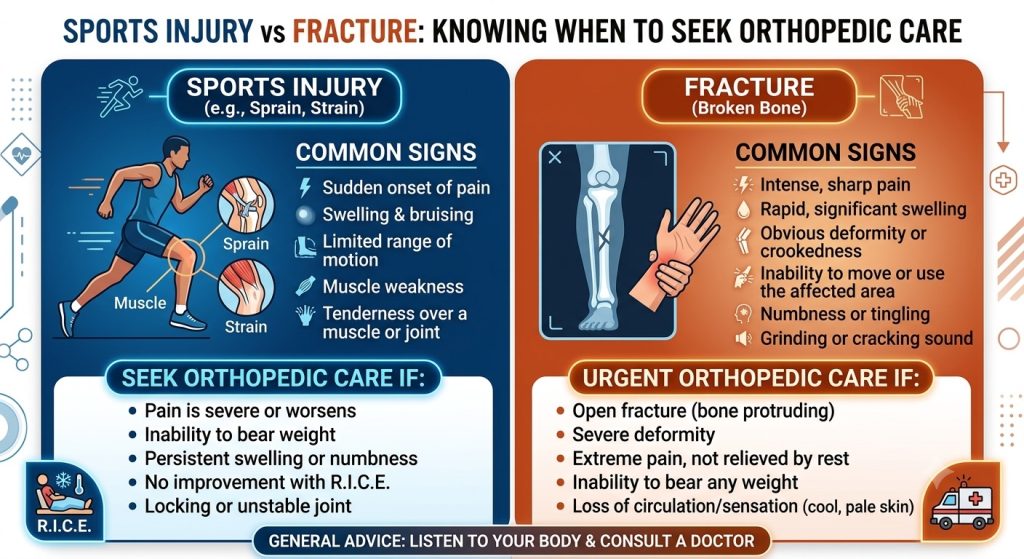
You twist your ankle going up for a rebound, or your knee buckles halfway through a workout. The first instinct is usually the same: ice it, rest it, it’ll be fine by Monday. And a lot of the time, it is. But not always — some injuries that look like a simple sprain turn out to be fractures or torn ligaments, and treating them like a sprain can end up costing you months of recovery later.
The tricky part is that a sprain and a fracture can feel almost identical in the first hour. Knowing what actually separates them is what gets you the right treatment before the window for an easy recovery closes.
What Is a Sports Injury?
Despite the name, you don’t need to be an athlete to get one. Sports injuries show up during a five-a-side match just as easily as during a jog around the block or a heavy day at the gym. Most trace back to one of a handful of causes:
- A sudden, awkward twist
- A fall
- A direct hit or impact
- Overusing a joint or muscle without enough recovery
- Skipping a proper warm-up
None of these, on their own, tell you how bad the damage actually is — that’s something only an examination can answer. A Sports Injury Orthopedic Doctor in Kakinada can look at how the injury happened and how it’s behaving now, then recommend treatment that actually matches the severity, rather than a one-size-fits-all approach.
What Is a Fracture?
A fracture is a different category of injury altogether — a crack or break in the bone itself, usually from a hard impact: a bad fall, a road accident, or a high-force sports collision. Unlike a sprain, it isn’t something you can wait out. Fractures typically need imaging to confirm what’s actually happened inside, and depending on how the bone has broken, surgery to put it back together correctly.
Common Sports Injuries
Not every injury under the skin is a fracture, though. Here’s how some of the more common ones typically show up:
|
Type of Injury |
Common Cause |
Common Symptoms |
| Sprain | Twisting a joint | Pain, swelling, limited movement |
| Strain | Overstretching a muscle or tendon | Muscle pain, weakness, stiffness |
| Ligament Tear (ACL) | Sudden change in direction during sports | Knee instability, swelling, pain |
| Meniscus Injury | Twisting the knee | Knee pain, locking, difficulty bending |
| Tendon Injury | Repetitive movements | Pain during movement, tenderness |
| Dislocation | Fall or direct impact | Joint appears out of place, severe pain |
| Stress Fracture | Repetitive physical activity | Pain that increases with activity |
Sports Injury vs Fracture: How Can You Tell the Difference?
On the surface, both look a lot alike — pain, swelling, a reluctance to move the way you normally would. But there are patterns worth paying attention to:
|
Sports Injury |
Fracture |
| Usually affects muscles, ligaments, or tendons | Involves a broken or cracked bone |
| Pain may improve with rest | Pain usually remains severe |
| Mild to moderate swelling | Significant swelling and tenderness |
| Movement may be painful but possible | Movement is often very difficult or impossible |
| Usually treated with rest, physiotherapy, or minor procedures | May require a cast, surgery, or specialized orthopedic care |
Even with these patterns in mind, the honest answer is that you often can’t be sure without an X-ray. That’s not a cop-out — swelling can mask a fracture just as easily as pain can make a sprain feel worse than it is. If the injury is serious enough to make you wonder, it’s worth getting it looked at.
Warning Signs You Should Not Ignore
A few signs shouldn’t wait for a “let’s see how it feels tomorrow” approach. Get it checked immediately if you notice:
- Severe pain right after the fall or injury
- A visible deformity — the joint or limb looks out of shape
- Difficulty standing or walking at all
- Heavy, fast swelling
- A popping sound at the moment of injury
- Numbness or tingling
- Pain that hasn’t eased after a day or two
Any one of these can point to a fracture or a serious ligament tear — not something to sit on.
How Are These Injuries Diagnosed?
Diagnosis usually starts simply — a physical exam, and a few questions about exactly how the injury happened, since the mechanism often tells doctors as much as the symptoms do. From there, depending on what they suspect, they might order:
- X-rays
- MRI scans
- CT scans
- Ultrasound, for soft tissue injuries
Together, these narrow down whether the problem is in the muscle, the ligament, the tendon, or the bone itself — which is really the question that decides everything about treatment.
Treatment Depends on the Injury
Once the diagnosis is clear, treatment splits into two fairly different paths. A sports injury is usually managed with:
- Rest
- Ice
- Compression
- Physiotherapy
- Bracing
A fracture asks for more:
- Casting or splinting
- Realigning the bone
- Surgery, if the break needs it
- Rehabilitation once the bone has healed
For the more severe cases — multiple fractures, complicated breaks, injuries that go beyond a simple cast — Complex Trauma and Fracture Management in Kakinada is built specifically to help patients rebuild movement and heal properly, rather than just immobilizing the injury and hoping for the best.
Why Early Orthopedic Care Matters
The earlier a doctor sees the injury, the more options they have — and the fewer complications tend to develop. Whether it’s a ligament tear, a muscle strain, or a fracture, getting ahead of it early usually means less pain along the way, a faster recovery, and a much lower chance of joint problems following you around years later.
Choosing the Right Care for a Faster Recovery
Not every injury needs the same level of intervention, and that’s exactly what a consultation helps sort out. A Sports Injury Orthopaedic Doctor in Kakinada can tell fairly quickly whether an injury will respond to conservative treatment or needs something more advanced — and for patients dealing with severe fractures or multiple injuries at once, Complex Trauma and Fracture Management in Kakinada is designed to support real healing and restore mobility, not just patch things up.
Between experienced specialists, proper imaging, and rehabilitation support all in one place, a Top Hospital In Kakinada gives patients a genuine path back to their normal routine — not just treatment, but a recovery worth trusting. For patients coming in from nearby towns, it’s also often considered the best Hospital near Rajahmundry for this kind of care, so getting the right diagnosis and treatment doesn’t mean a longer trip.
About Post Author





More Stories
Improving Biomarker Measurement Through Advanced Chemiluminescence Quantification Methods
How Silica Column RNA Extraction Kits Deliver Efficient and High-Purity RNA Isolation
COVID-19 Self-Testing: Understanding Test Procedures, Accuracy, and Reliable Results at Home